Chiropractic Cavitation: More Than a Snap, Crack or Pop
A large percentage of the Chiropractic videos on YouTube sell “crack”. These videos will tout how “loud, crunchy and poppy” their adjustments are. Some will actually place microphones on the spine or edit their videos to enhance the “cracking” noise. While these videos are somewhat deceptive and not an exact representation of Chiropractic, there is an element of truth to them as well.
The noise sometimes heard during an adjustment is called a cavitation. A cavitation is a normal occurring event that can take place during an adjustment. Inside a joint, bubbles of carbon dioxide are created due to a rapid change of pressure. Different studies show that the gas bubbles will either collapse on themselves or release out into the synovial fluid to only be absorbed back into the joint. In either case, the bubbles create the “popping” sound. If you have ever “popped” or “cracked” your knuckles, the same overarching theory of the cavitation occurs.
A cavitation itself is harmless, but the sound can be surprising. And often when we get surprised, that split second of the unknown can elicit different responses. Our brains are hardwired to respond to that uncertainty on an emotional level. Those “adjustment” videos play on our emotions of suspense.
A true adjustment is a controlled force, employing leverage, direction, amplitude and velocity. It is applied to a specific vertebra for the purpose of correcting a vertebral subluxation. This definition is essential.
An adjustment considers a vertebra, singular, not vertebrae, plural that is subluxated. If you want loud and numerous “pops”, you would need to put force, leverage, direction, amplitude and velocity into multiple spinal bones at one time. This is a departure from specificity and into the realm of manipulation. Also for a proper adjustment to occur the patient should be supported in a static position. Simply put: If you need to move the whole patient to move the bone, too much force is at play.
This might sound like a tangent, but let’s talk about opening a bottle of wine. Hopefully I can connect the dots to an adjustment.
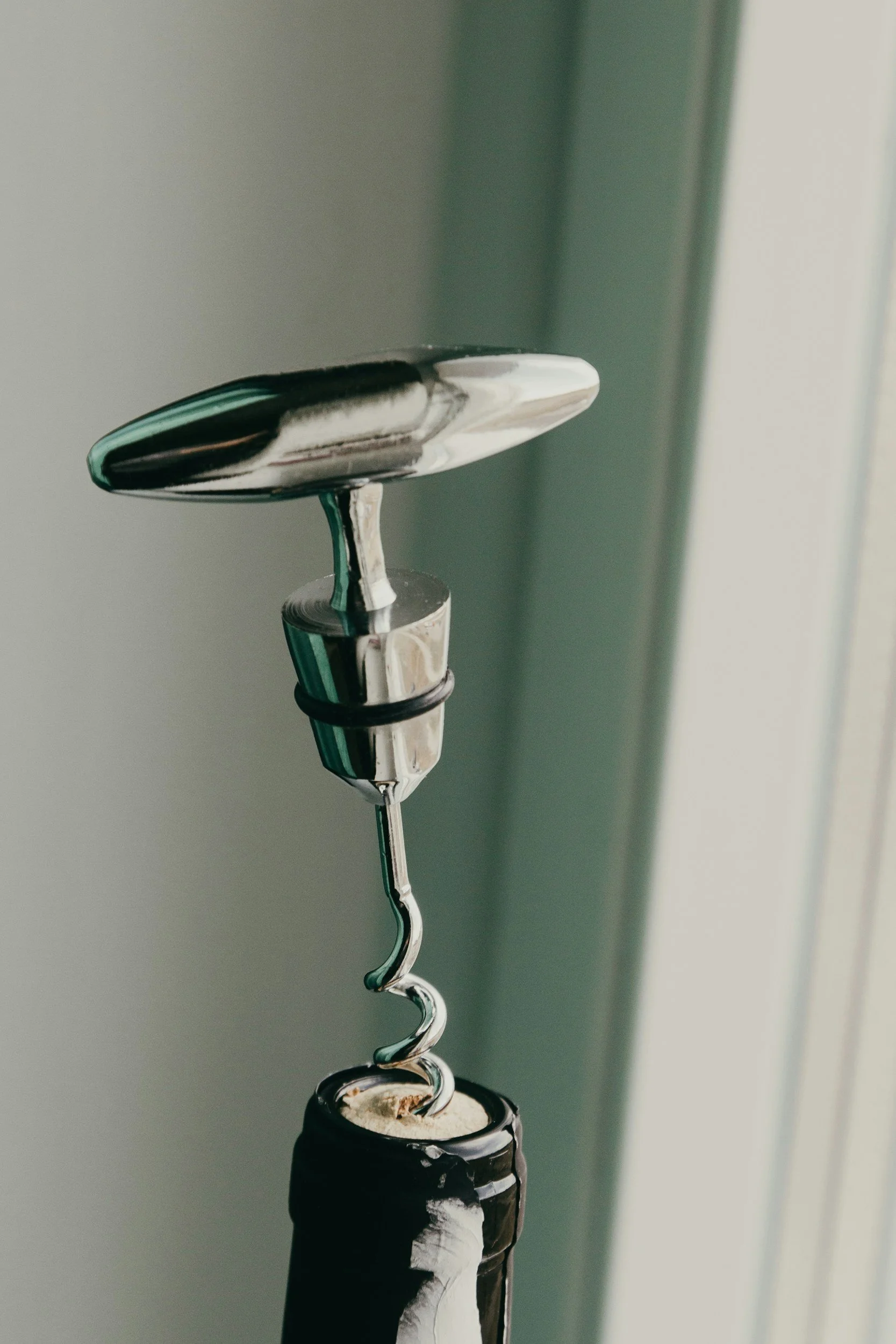
The simplest and easiest way to open a bottle of wine is with a corkscrew. This is where the bottle is held in a static position and using a specific force, leverage, direction, amplitude and velocity, the corkscrew easily and quickly removes the cork.
If you do a YouTube search on “how to open a bottle of wine”, you will find many different and crazy ways to open the bottle with and without a corkscrew. One in particular, requires a shoe and a wall. The “hack” involves you placing the wine bottle in the heel portion of the shoe, cork side out. Then with all your might, you bang the shoe against a wall repeatedly until the cork slowly comes out.
I hope it is easy to see that the “shoe and wall” trick is similar to the popular “crack-inducing” adjustment videos found online. What video would get more views: one where a bottle of wine is opened with a corkscrew or one that is opened with a shoe? The same principle occurs with videos that have the “loudest, most crunchy, neck popping, back cracking adjustments ever!”
My main concern is not how many cavitations I can create in your spine. My main objective is to adjust a vertebral subluxation in a precise manner, allowing your body to function more optimally. Your health is more important than “snaps, crackles and pops.”
- Jarek Esarco, DC, CACCP
Related Blogs:
Other Resources:
Jarek Esarco, DC, CACCP is a pediatric, family wellness and upper cervical specific Chiropractor. He is an active member of the International Chiropractic Pediatric Association (ICPA). Dr. Jarek has postgraduate certification in Pediatric Chiropractic through the ICPA. Dr. Jarek also has postgraduate certification in the HIO Specific Brain Stem technique through The TIC Institute. Dr. Jarek is happily married to his wife Regina. They live in Youngstown, Ohio with their daughter Ruby.