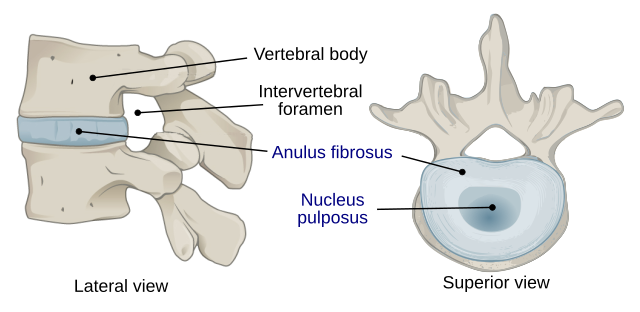
In between each bone of the spine is a special type of connective tissue called an intervertebral disc. The disc has a fibrous outer ring and a jelly-like material on the inside. This soft center acts like a “ball-bearing” and helps with joint movement. The discs attach directly to the vertebrae above and below and prevent them from actually “slipping.”
A “slipped disc” is a misnomer and is similar in misuse to the phrase “pinched nerve.” A “slipped disc” is a layman’s term used by some chiropractors and other healthcare professionals to explain an injury to the intervertebral disc. While a disc can’t “slip”, it can bulge, tear, herniate, thin, prolapse and dry out.
The upper cervical spine is unique regarding intervertebral discs. There is no disc found between the base of the skull and the atlas bone. There is also no disc found between the atlas bone and the axis bone.
The lack of intervertebral discs found in the upper cervical spine contributes to its mobility. Over 50% of neck motion occurs in the joints between the occiput, atlas and axis bones. Although the upper cervical spine has a great capacity for motion, stability is compromised.
Without intervertebral discs, muscles and ligaments must carry the load of stabilizing the upper cervical spine. This makes it susceptible to injury. One type of injury that occurs in the upper cervical spine is a vertebral subluxation.
A vertebral subluxation causes the upper cervical spine to lock in a misaligned position. This obstructs the Nerve System and how it functions.
Chiropractors correct this through specific adjustments to the upper cervical spine. Adjustments better optimize the function of the Nerve System. Nerves can sense, perceive and behave at a greater potential when a subluxation is corrected.
- Jarek Esarco, DC, CACCP
Related Blogs:
Other Resources:
Jarek Esarco, DC, CACCP is a pediatric, family wellness and upper cervical specific Chiropractor. He is an active member of the International Chiropractic Pediatric Association (ICPA). Dr. Jarek has postgraduate certification in Pediatric Chiropractic through the ICPA. Dr. Jarek also has postgraduate certification in the HIO Specific Brain Stem technique through The TIC Institute. Dr. Jarek is happily married to his wife Regina. They live in Youngstown, Ohio with their daughter Ruby.