
Chiropractic and Stroke
There is no human experimental evidence that Chiropractic adjustments cause a stroke. End of discussion, right? I wish it were that easy. If there is no causal link, where does this idea come from? First, we need a little historical background on this topic.
Since 1895, Chiropractic has faced medical opposition. How come? Was it because Chiropractic is quackery and is dangerous to public health? Of course not. The real reason: competition. In the 19th and early 20th centuries, the U.S. healthcare system was controlled by the American Medical Association. The AMA at the time was not willing to accept any new approach to health intervention and instead sought to dismantle any competition.
The first attack against Chiropractic was to jail chiropractors for “practicing medicine without a license.” Then, the AMA started to create scathing reports about Chiropractic in medical journals. In 1947, the Journal of the American Medical Association (JAMA) began making claims that a Chiropractic adjustment was a “severe trauma” to the spine. Then, in 1963, the AMA created an official “Committee on Quackery.” Joseph Sabatier, the chairman of the committee, said that “rabid dogs and chiropractors fit into about the same category…. Chiropractors were nice but they killed people.”

These fabrications, though, were not based on any scientific research. And since Chiropractors were barred from publishing research in JAMA that would challenge the misinformation, they continued unchecked. Finally, in 1987, after many lawsuits filed by Chiropractors, the U.S. District Courts confirmed that the AMA had violated the Sherman Antitrust Act. The U.S. Court asserted that “the AMA decided to contain and eliminate chiropractic as a profession” and that it was the AMA’s intent “to destroy a competitor.”
Even though justice was served in the courts, years of medical disinformation created a false identity in the public's eye of Chiropractic. Chiropractors are tasked with reeducating the public (and medical doctors) on what Chiropractic is and is not, and what an adjustment does and does not do. Even today, I will have some patients come into my office concerned that an adjustment will cause a stroke because their medical doctor said so. Facts might be on the side of Chiropractic, but belief systems don’t always line up with the truth. With this history in mind, let’s address the topic at hand.
First, let us define what a stroke is. A stroke is also known as a cerebrovascular accident or brain attack. It is when poor blood flow to the brain causes cell death. There are two main types of stroke: ischemic, due to a lack of blood flow, and hemorrhagic, due to bleeding. A blockage in the arteries leading to the brain is the main cause of strokes. A stroke can cause multiple symptoms, such as one-sided numbness or weakness in the face or extremities, confusion or trouble understanding other people, difficulty speaking, trouble seeing with one or both eyes, problems walking or staying balanced or coordinated, dizziness, and severe headache and neck pain that comes on for no reason.
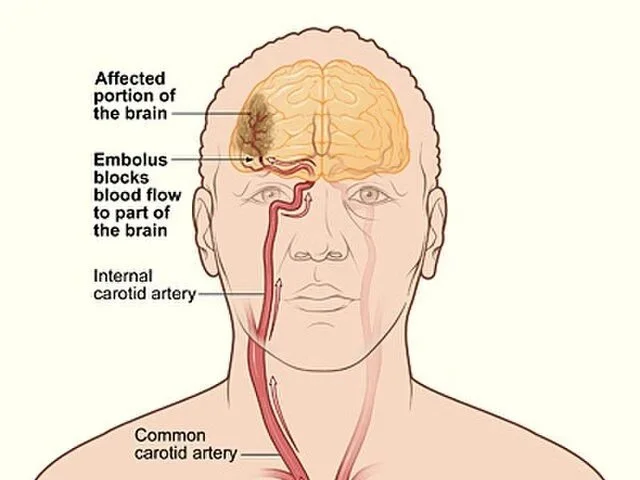
About 87% of all strokes are ischemic in nature. One cause of an ischemic stroke is a cervical artery dissection. A cervical artery dissection, or CAD for short, occurs when one of the blood vessel walls in the neck tears. This tear can cause blood clots to form in your arteries, affecting the blood supply to your brain. Symptoms of CAD include numbness and weakness on one side of your body, difficulties with your speech, loss of sight in one eye, confusion, one-sided face drooping, problems with coordination and severe headache and neck pain that comes on for no reason.
The exact cause of a cervical artery dissection is unknown, but there are many theories. Some theorize that extension and/or rotation of the neck can damage the vertebral artery, particularly within the transverse foramen at the C1–C2 level, tearing the vessel wall and resulting in blood clots. Other theories include sudden or sustained rotation and extension of the neck, motor vehicle collisions, sports accidents, lifting, working overhead, falls, sneezing, and coughing are possible mechanisms of injury.
Putting theories aside, the majority of CAD cases actually occur spontaneously. They also involve other risk factors such as connective tissue disorders, migraine, hypertension, infection, vessel abnormalities, atherosclerosis, central venous catheterization, cervical spine surgery, cervical percutaneous nerve blocks, radiation therapy and diagnostic cerebral angiography.
If we look at the theory that alleges sudden extension and/or rotation of the neck can cause CAD, we can see how this leads to the claim that an adjustment can cause a stroke. So then, does a Chiropractic adjustment cause a stroke? To answer this, we need to know the difference between causation and correlation.
Causation occurs when one variable directly causes a change in another, thereby forming a cause-and-effect relationship. For example, the sun causes your ice cream to melt. Correlation is the interdependence of variable quantities. Two unconnected events can have an observed association with each other without actually having a cause-and-effect relationship. For example, the sun causes your ice cream to melt and causes your skin to tan. This does not mean your tanning skin causes your ice cream to melt or vice versa. The melting ice cream and tanning skin are correlated events unconnected to a similar cause. Simply put, “correlation does not imply causation.”

Let’s look at some research surrounding the question: Does a Chiropractic adjustment cause a stroke?
First, a study from 2008 titled “Risk of Vertebrobasilar Stroke and Chiropractic Care.” This was a population-based, case-control and case-crossover study that gathered information from 1993 to 2002. Quoting this article: “Our study shows an association between chiropractic visits and VBA (Vertebrobasilar Artery) strokes. However, we found a similar association between primary care physician visits and VBA stroke.”
What does this mean? Why is there an association between Chiropractic visits and not the adjustment?
A Chiropractic visit usually involves an adjustment. A visit to the medical doctor does not include an adjustment. This study found that the incidence of a stroke is similar for both Chiropractic visits and medical doctor visits. Since medical doctors do not perform adjustments, you can’t state that the adjustment alone is a direct cause of a stroke. A Chiropractic visit and a medical doctor visit are correlated events to a stroke; they don’t necessarily show causality.
Quoting again from the 2008 study: “The increased risks of VBA stroke associated with chiropractic and PCP visits is likely due to patients with headache and neck pain from VBA dissection seeking care before their stroke.”
The majority of people seek Chiropractic or medical care when they have a problem. A sign or symptom presents itself and a patient seeks help. Symptoms such as headaches, neck pain, dizziness, numbness/tingling and muscle weakness are common reasons why a person sees a Chiropractor. These symptoms are also common to CAD and stroke. These symptoms are also common to many other conditions, such as dehydration, cardiovascular disease, and vertebral subluxation. This type of association between an adjustment and a stroke is based on temporality. This means the patient was already in the midst of a dissection or stroke, or was going to have one anyway and just so happened to have seen a chiropractor during that time frame.

Even with this information, some still say that a Chiropractic adjustment is plausible as a mechanism of injury that can cause a stroke. The claim is that an adjustment puts undue strain on the vertebral arteries, stretching them to the point of causing ischemic tears. How might we refute this?
First, a study from 2012 published in the Journal of Electromyography and Kinesiology titled “Vertebral artery strains during high-speed, low amplitude cervical spinal manipulation.” This study examined the point of mechanical failure of the vertebral arteries. Using fresh, unembalmed human cadavers, the scientists measured the strain put on the vertebral arteries through the cervical spine’s normal range of motion. They also measured the strain placed on the arteries through a Chiropractic adjustment.
The results concluded that the strain placed on the cervical arteries during a Chiropractic adjustment was significantly lower than the strain placed on the arteries during normal cervical neck movements. The adjustment on average only reached about 28% of the amount of vertebral artery strain that occurs during normal cervical range of motion and only 10% of average failure strains. Quoting the study, “We conclude from this work that cervical SMT (an adjustment) performed by trained clinicians does not appear to place undue strain on VA (vertebral arteries), and thus does not seem to be a factor in vertebro-basilar injuries.”
A similar study was published in 2015 in the Journal of Manipulative and Physiological Therapeutics titled “Internal Carotid Artery Strains During High-Speed, Low-Amplitude Spinal Manipulations of the Neck.” This study measured the strain put on the internal carotid arteries during a Chiropractic adjustment and normal cervical movements. Again, the findings indicated that the “average strains of the internal carotid arteries for cervical spinal [adjustments] were significantly smaller than the corresponding strains obtained for the ROM and diagnostic testing.” The researcher found that a Chiropractic adjustment “did not appear to place undue strain on the Internal Carotid Arteries and thus does not seem to be a factor in Internal Carotid Artery injuries.”
Let’s look at one more important study. In 2016, The Cureus Journal of Medical Science published the article “Systematic Review and Meta-analysis of Chiropractic Care and Cervical Artery Dissection: No Evidence for Causation.” This article applied The Hill criteria to reach its conclusion. Sir Austin Bradford Hill was the famed epidemiologist and statistician who pioneered the randomized clinical trial. It was through his work that he made the connection between cigarette smoking and lung cancer. Hill’s criteria became the gold standard in public health research to establish epidemiologic evidence of a causal relationship between a presumed cause and an observed effect.
In this 2016 systematic review and meta-analysis, the researchers found “no convincing evidence to support a causal link between chiropractic manipulation [adjustment] and Cervical Artery Dissection [CAD].” Furthermore, they state that even though “the very weak data supporting an association between chiropractic neck manipulation and CAD” exists, an assumed relationship by many clinicians “seems to enjoy the status of medical dogma” in the “absence of adequate and reliable data.”
I really appreciate the two-fold nature of this study. Not only does it utilize the scientific gold standard to discredit any causality between a chiropractic adjustment and a stroke; it also points out that any notion that it does is based not on facts, but a belief system.

And it is this last point where the matter rests. Until medical belief systems change on this topic, Chiropractic will always be on the defensive. No mountain of research can change convictions. But to quote one of my favorite lines from Fyodor Dostoyevsky, “Everything passes, only truth remains.” Hopefully, with time, the truth can wiggle free and set the record straight.
- Jarek Esarco, DC, CACCP
Resources:
Cassidy, J. D., Boyle, E., Côté, P., He, Y., Hogg-Johnson, S., Silver, F. L., & Bondy, S. J. (2008). Risk of Vertebrobasilar Stroke and Chiropractic Care: Results of a Population-Based Case-Control and Case-Crossover Study. European Spine Journal, 17(Suppl 1), 176–183. https://doi.org/10.1007/s00586-008-0634-9
Herzog, W., Leonard, T. R., Symons, B., Tang, C., & Wuest, S. (2012). Vertebral artery strains during high-speed, low amplitude cervical spinal manipulation. Journal of electromyography and kinesiology : official journal of the International Society of Electrophysiological Kinesiology, 22(5), 740–746. https://doi.org/10.1016/j.jelekin.2012.03.005
Herzog, W., Tang, C., & Leonard, T. (2015). Internal Carotid Artery Strains During High-Speed, Low-Amplitude Spinal Manipulations of the Neck. Journal of manipulative and physiological therapeutics, 38(9), 664–671. https://doi.org/10.1016/j.jmpt.2012.09.005
Church, E. W., Sieg, E. P., Zalatimo, O., Hussain, N. S., Glantz, M., & Harbaugh, R. E. (2016). Systematic Review and Meta-analysis of Chiropractic Care and Cervical Artery Dissection: No Evidence for Causation. Cureus, 8(2), e498. https://doi.org/10.7759/cureus.498
Related Blogs:
Is Chiropractic Care Safe?
Just How “Severe” is an Adjustment?
Joe Rogan: “Chiropractic is 98% Bull$#it!”