Cranial Nerve/Spine Connection

For purposes of learning anatomy, the structures of the body, we often group sections of the body into smaller parts for easier study. For example, nerves are divided into different systems, organs, tissues and cells. How these parts work and interact with other parts is the realm of physiology, the function of the body. 

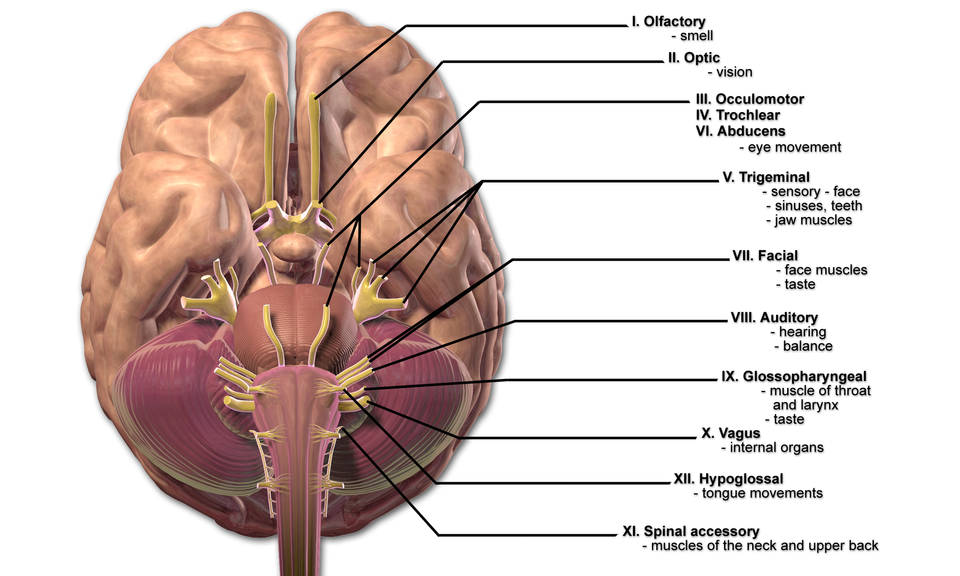
Anatomically speaking, cranial nerves are located in the cranial vault, the skull. The 12 cranial nerves and their primary functions, are as follows:

  • II (1) Olfactory: Smell.

  • II (2) Optic: Vision.

  • III (3) Oculomotor: Eye movement, pupil control, eyelid elevation.

  • IV (4) Trochlear: Eye movement.

  • V (5) Trigeminal: Facial sensation, chewing.

  • VI (6) Abducens: Outward eye movement.

  • VII (7) Facial: Facial expression, taste.

  • VIII (8) Vestibulocochlear: Hearing and balance.

  • IX (9) Glossopharyngeal: Taste, gag reflex, swallowing.

  • X (10) Vagus: Sensation/motor control of thoracic/abdominal organs, gag reflex.

  • XI (11) Spinal Accessory: Head movement.

  • XII (12) Hypoglossal: Tongue movement.
Physiologically speaking, cranial nerves communicate and connect with spinal and peripheral nerves. Quoting from the Professor of Neurology at the Palmer School of Chiropractic, Dr. H. C. Chance, D.C., Ph.C: 

“Clinically, all cranial nerves have a spinal connection. However, anatomically, not much is known. For example, the anatomist has not made this connection with the acoustic nerve, but its spinal connection was proved clinically when D. D. Palmer adjusted Harvey Lillard, and this was the basis of the discovery of the science of Chiropractic. Since that time we have repeatedly obtained results through other cranial nerves by adjusting the spine.”

Clinical observations are glimpses into how structure functions. The physiology of anatomy. How life animates material. When D.D. Palmer gave the first adjustment to Harvey Lillard’s spine, he clinically observed that the spine was connected to the cranial acoustic nerve in some way not yet known. D.D. Palmer made this observation: “The cranial nerves may be injured by pressure in the part of the brain which gives them origin, or along the pathways of the nerves themselves.” This became the catalyst for Chiropractic.

Cranial nerves innervate many different systems, organs, glands and tissues of the body. Spinal nerves innervate many different systems, organs, glands and tissues of the body as well. Many cranial nerves and spinal nerves share similar pathways en route to innervate different systems, organs, glands and tissues of the body. Also, some cranial nerves and spinal nerves innervate the same systems, organs, glands and tissues of the body.

If we take a step back from observing nerves through different systems, organs, tissues, cells, and innervations, we can see they all have a common denominator, the brain. Quoting again from Dr. H. C. Chance: 

“The real origins or determinations of spinal nerves, cranial nerves and peripheral visceral nerves are in the cortex of the brain.”

To simplify, the brain stores information and generates electrical signals. The brain uses nerve fibers in the form of spinal nerves, cranial nerves and peripheral visceral nerves to send that information out to the body. Quoting Dr. Harry Vedder, DC: 

“Not only do we think through our brain, but the impulse resulting from this thought is transmitted through the spinal cord or cranial nerves, is conveyed through the spinal nerves, ganglia, etc., and is expressed through the tissue cells which function because of it.” 

There are also nerve fibers at every organ, gland and tissue of the body that send information back up to the brain for interpretation. All the trillions of nerves that make up the Nerve System communicate with each other and the brain in a complete, unbroken cycle. 

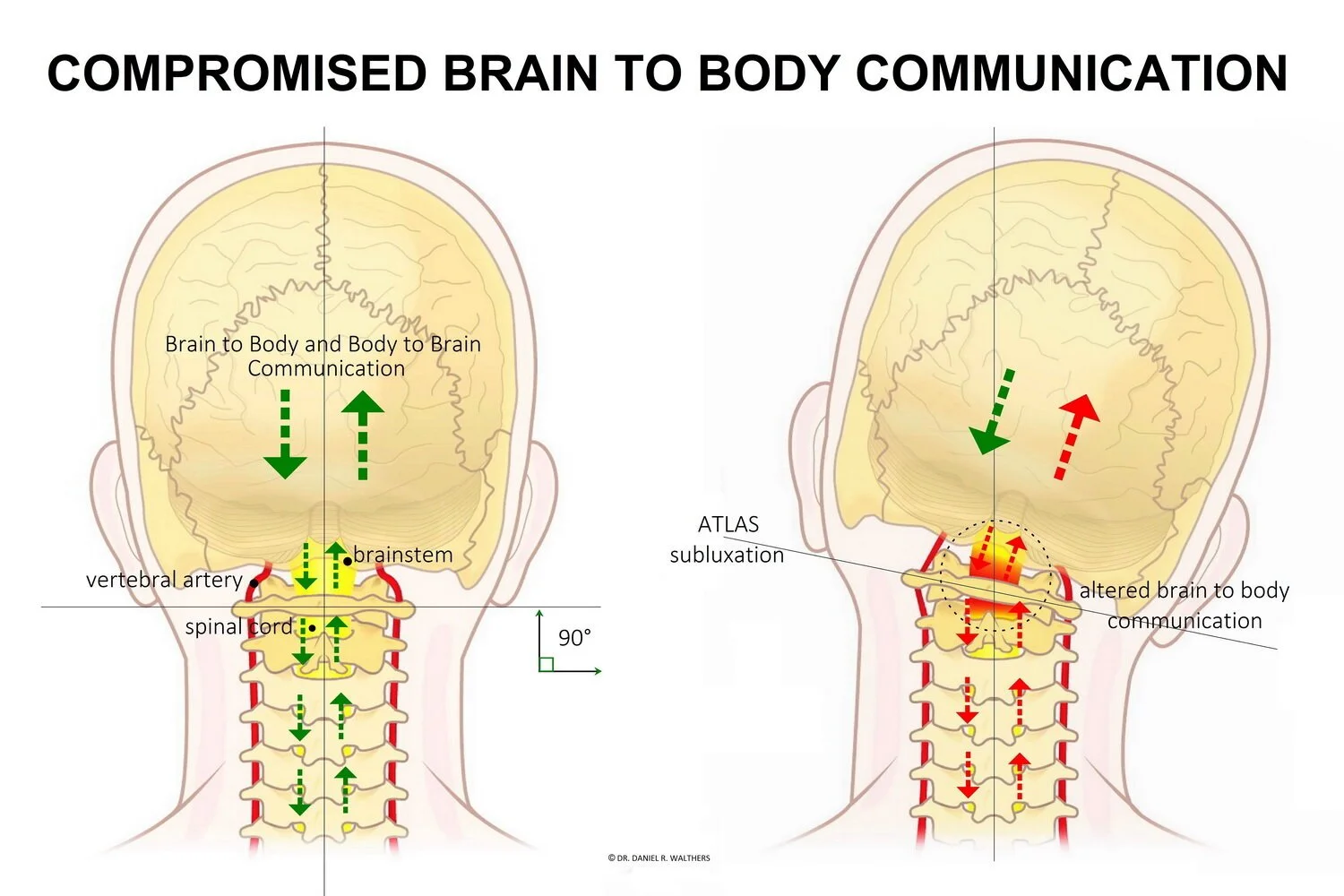
If there is a breakdown in communication anywhere along that nerve cycle, miscommunication can happen throughout. A major contributor to “communication breakdown” is a vertebral subluxation. A vertebral subluxation interferes with the normal transmission, communication and interpretation of Nerve System impulses. 

An important meet-up point in the cycle of nerve communication occurs at the upper cervical spine. The upper cervical spine protects and surrounds the lower portion of the medulla oblongata. Quoting once again from Dr. H.C. Chance, D.C.:

“[The medulla oblongata] is the connection of brain with spinal cord. It has located within it many nuclei which are the nuclei of origin or nuclei of termination of many of the cranial nerves.” 

The goal of Chiropractic is to improve the potentiality of the entire Nerve System, not just nerves localized to the spine. Chiropractor focuses on the spine because it is the main conduit for nerve transmission from the brain to the body. A spinal adjustment is the means, optimizing Nerve System function is the end.

- Jarek Esarco, DC, CACCP

Related Blogs:


Other Resources:


Jarek Esarco, DC, CACCP is a pediatric, family wellness and upper cervical specific Chiropractor. He is an active member of the International Chiropractic Pediatric Association (ICPA). Dr. Jarek has postgraduate certification in Pediatric Chiropractic through the ICPA. Dr. Jarek also has postgraduate certification in the HIO Specific Brain Stem technique through The TIC Institute. Dr. Jarek is happily married to his wife Regina. They live in Youngstown, Ohio with their daughter Ruby.

Jarek EsarcoComment